International Conference on Convergent Technologies 2026 (ICCT 2026)
21–22 October 2026 | ENSA Khouribga, Morocco
Hosted by: École Nationale des Sciences Appliquées (ENSA), Khouribga
Submission Portal: https://cmt3.research.microsoft.com/ICCTECH2026
Submission Deadline: : 15 July 2026 10 August 2026
Conference Overview
The International Conference on Convergent Technologies (ICCT 2026) invites research students, doctoral candidates, professors, academic researchers, and industry R&D specialists to submit original, unpublished research papers. This conference serves as a premier interdisciplinary forum to explore the synergies between Artificial Intelligence, the Internet of Things, Cybersecurity, Communication Systems, and Smart Engineering. ICCT 2026 is dedicated to fostering collaboration, showcasing pioneering research, and addressing the complex challenges at the intersection of these transformative fields. All accepted and presented papers will be submitted for inclusion into
Paper Submission:
Authors are invited to submit their full papers by August 10, Manuscripts submitted for the conference must be original, must not be previously published or currently under review anywhere. Submitted manuscripts should respect the standard guidelines of the Springer proceeding chapter format. Manuscripts must be prepared using Latex, or Word. The submitted paper must be formatted according to Springer Format: MS Word Template, Latex Template.
The paper should contain 8 pages. Contributions MUST be in English. All submitted manuscripts will be peer-reviewed by at least 2 program committee members. Prospective authors should send their manuscripts electronically through the CMT microsoft submission system.
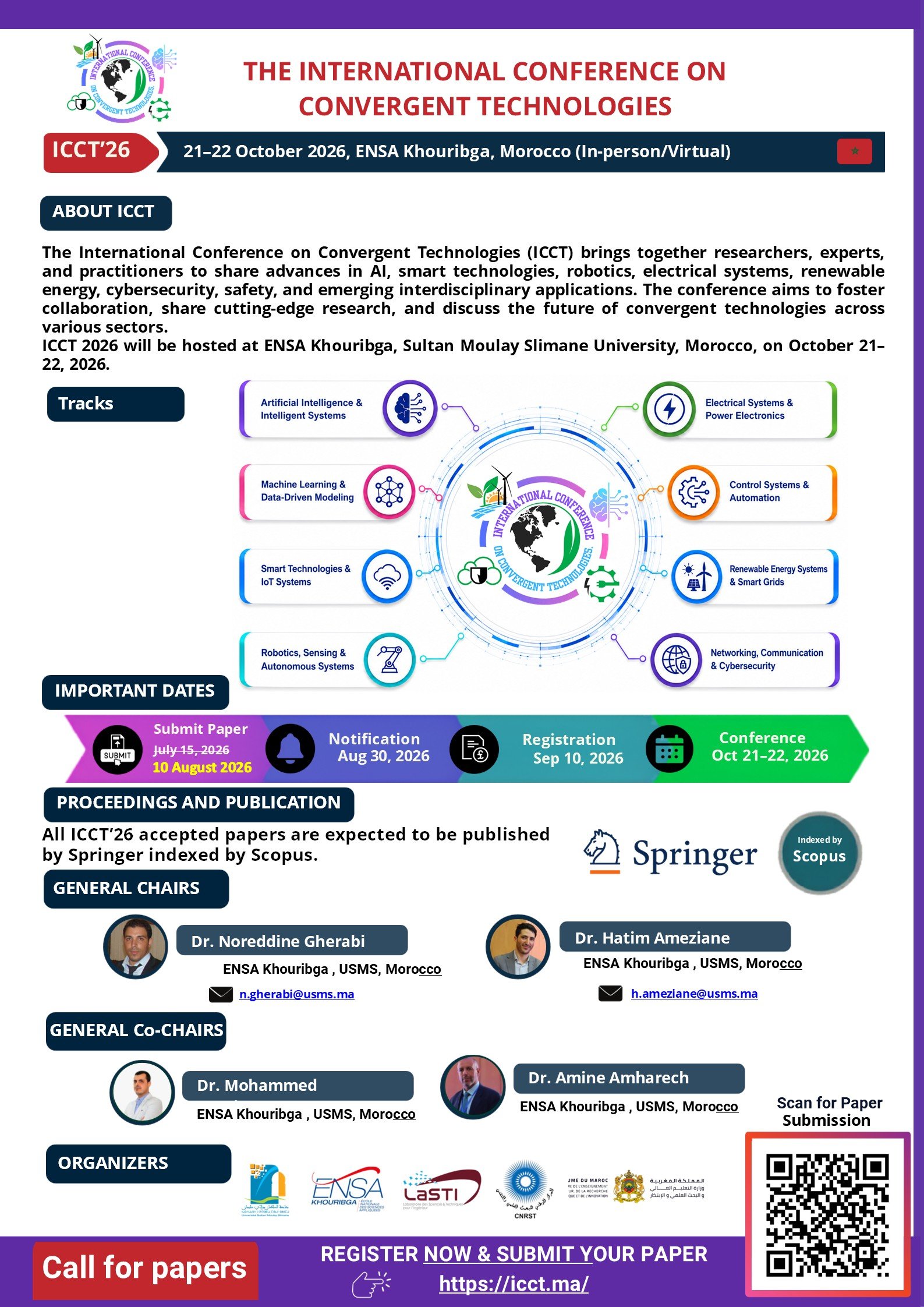
Conference Tracks
Track 1: Artificial Intelligence & Intelligent Systems
- AI methods and applications
- Intelligent systems and decision support
- Machine learning and deep learning
- Computer vision and pattern recognition
- Explainable and trustworthy AI
Track 2: Computational Intelligence & Web Technologies
- Computational intelligence and soft computing
- Web technologies and intelligent applications
- Data science and knowledge discovery
- Semantic web, cloud platforms, and services
- Optimization and decision-support methods
Track 3: Smart Technologies & IoT Systems
- IoT architectures and platforms
- Smart sensors and connected devices
- Smart cities, homes, and environments
- Edge computing and IoT data processing
- Industrial IoT and smart applications
Track 4: Robotics, Sensing & Autonomous Systems
- Robotic perception and sensor fusion
- Autonomous navigation and planning
- Mobile robots, drones, and intelligent machines
- Human-robot interaction
- Industrial robotics and autonomous control
Track 5: Electrical Systems & Power Electronics
- Power electronics and converters
- Electrical machines, drives, and conversion
- Electrical modeling and diagnostics
- Power quality, harmonics, and EMC
- Industrial electrical applications
Track 6: Control Systems & Automation
- Control theory and advanced strategies
- Automation and industrial control
- Embedded and real-time control
- Modeling and system identification
- Fault diagnosis and predictive control
Track 7: Renewable Energy, Smart Grids & Green Hydrogen
- Solar, wind, and hybrid energy systems
- Smart grids and microgrids
- Energy storage and management
- Green hydrogen technologies
- Digital twin for energy systems
Track 8: Networking, Cybersecurity & Safety Technology
- Networking and communication systems
- Cybersecurity and secure communications
- IoT security and trusted systems
- Safety, risk, and reliability
- Resilience and emergency support